25 Essential Facts About Engagement Rings: Diamonds, Settings, Costs, Care, and Buying Smarter
Buying an engagement ring today means navigating more than just jewelry—it means navigating expectations. For decades, tradition and marketing shaped what a ring “should” look like. Today, that influence is still there, but it’s been reshaped by social media, modern values, and changing priorities. You’ll still see diamonds dominating proposals, but you’ll also see lab-grown stones, colored gems, and highly personalized designs gaining ground.
The result is a mix of old and new: tradition, practicality, and personal expression all competing for attention. Understanding how engagement rings actually work—from pricing to design to long-term care—helps you make decisions based on reality, not pressure. These essential facts break down what matters most, so you can buy smarter and with confidence.
1- What Makes Diamonds the Default Engagement Ring Choice
Diamonds didn’t become the standard by accident. The famous “A Diamond is Forever” campaign didn’t just sell jewelry—it reshaped culture. It linked diamonds to permanence and commitment so effectively that they still dominate engagement rings today.
Even now, most buyers still choose diamonds, largely because of that cultural weight. Durability, brilliance, and tradition keep them at the forefront. But that dominance is evolving.
Modern buyers are more informed and more flexible. Lab-grown diamonds now make up a significant portion of purchases, offering the same visual and physical qualities at a lower cost. At the same time, colored gemstones and vintage designs are gaining popularity, especially among buyers looking for something less conventional. The shift isn’t away from diamonds—it’s toward choice.
2- The 4Cs Every Engagement Ring Buyer Needs to Understand First
Choosing a diamond means traversing more than cultural expectations and price tags—it means understanding what actually determines a diamond's quality. The GIA created the universal 4Cs framework so you can evaluate diamonds consistently before committing to any ring design or custom enhancements.
Here's what each C actually means for you:
- Cut — Determines brilliance and sparkle; prioritize this above everything else
- Color — Graded D to Z; near-colorless stones often appear identical to flawless ones
- Clarity — Many lower-graded diamonds remain eye-clean without magnification
- Carat — Weight influences price, but a smaller, better-cut diamond can outshine a larger, inferior one
These four factors work together. Understanding their interaction helps you spend confidently and choose wisely. When evaluating cut specifically, the GIA assesses seven distinct components—including brightness, fire, scintillation, polish, and symmetry—to determine an overall cut grade ranging from Excellent to Poor.
3- What the Average Engagement Ring Actually Costs in 2025
Carat weight has the biggest influence on price, but it’s also the most misunderstood. Price doesn’t increase gradually—it jumps at key thresholds like 1.0 or 1.5 carats. That means choosing just below those marks can save money without changing how the diamond appears.
This is where modern buying behavior differs from the past. Instead of chasing size alone, buyers are balancing size with quality and budget. Lab-grown diamonds have accelerated this shift, making larger stones more accessible without dramatically increasing cost.
Social media has also played a role. Larger stones are more visible and more frequently shared, which can influence expectations. But in real life, proportion and design often matter more than raw size.
4- Carat Size Drives Price More Than Any Other Factor
Of all the factors shaping an engagement ring's price, carat size carries the most weight — literally and financially. Research shows carat explains 87.9% of price variation — more than cut, color, or clarity combined. Diamond trade associations confirm prices jump sharply at quarter-carat thresholds, not gradually.
A 1-carat natural diamond ranges from $2,000 to $16,000 depending on quality. Crossing the 1.5-carat mark triggers a significant price surge. A 3-carat natural diamond costs 16 times more than its lab-grown equivalent. Online ring customization tools reveal how half a carat can double your total cost.
Choosing your carat wisely before adjusting other quality factors saves money without sacrificing beauty. In 2025, the average stone size across engagement ring purchases was 1.16 carats, reflecting how most buyers’ balance quality and budget within a practical range.
Add another pinch of knowledge with these fascinating engagement ring facts.
5- The Most Popular Engagement Ring Diamond Cuts Ranked
While carat size shapes your budget, the diamond's cut determines how your ring looks and feels on her finger. Round brilliant cuts dominate sales, comprising over 50% of engagement rings, and their 57-58 facets maximize sparkle beautifully in split shank designs.
Princess cuts rank second, offering geometric modern appeal at lower price-per-carat. Cushion cuts balance vintage-inspired silhouettes with brilliant light performance, making them consistently popular across multiple rankings. Emerald cuts deliver sophisticated rectangular elegance but require VS2 clarity or better since their large step facets expose every inclusion.
Each cut carries distinct personality, so matching her style to the right shape matters as much as the stone's size. Oval, pear, and marquise cuts are currently dominating engagement ring trends, reflecting a broader industry shift toward elongated shapes that create a finger-flattering, larger appearance.
6- Round vs. Oval vs. Princess: Which Cut Actually Wins?
Three shapes dominate the engagement ring market, but each wins on different terms. Your choice depends on what matters most to you personally. Round delivers unmatched sparkle, reflecting nearly 100% of light through its unique cut features, though it costs 10–30% more.
Oval offers diamond shape versatility, appearing 10–15% larger than round at the same carat weight while elongating your fingers beautifully. Princess gives you a bold, contemporary look with significant savings, though its pointed corners risk chipping over time.
Your lifestyle wins when you match the cut to your priorities — brilliance, budget, or bold style. No single cut objectively wins. Round wins on sparkle, oval wins on value, and princess wins on modern edge. Round dominates engagement rings, capturing nearly 60% of all purchases thanks to its unrivaled brilliance.
7- What Diamond Clarity Grades Mean for Your Engagement Ring
Once you've chosen your diamond's shape, clarity becomes your next big decision — and the GIA's standardized grading scale makes it easier to navigate. Established in 1953, the scale runs 11 grades across six categories, from Flawless to Included 3, all assessed under 10x magnification.
Understanding diamond inclusion patterns helps you choose wisely. Flawless and Internally Flawless grades are rare and pricey, while VS and SI grades offer strong value — most appear eye-clean despite minor inclusions. Grades drop based on inclusion size, number, position, and contrast against the stone.
Just as diamond color distinctions affect pricing and appearance, clarity directly impacts brilliance and durability. I3 diamonds can show visible flaws and structural weakness, so prioritize at least SI1 for an engagement ring that stays beautiful long-term. Surface flaws and inclusions are classified differently, with blemishes referring to external imperfections and inclusions describing characteristics found within the diamond itself.
8- VS2 and SI1: The Sweet Spot for Engagement Ring Value
Most buyers find their ideal balance in VS2 and SI1 diamonds, where quality meets affordability without sacrificing beauty. Both grades deliver strong stone appearance while keeping costs realistic, making them the ultimate value compromise for engagement rings.
Why VS2 and SI1 Win Hearts:
- Both grades look eye-clean to untrained observers, so she'll never notice imperfections.
- You'll redirect savings toward carat size or cut quality, maximizing her reaction.
- VS2 offers consistent flawless appearance, while SI1 stretches your budget even further.
- Round brilliant cuts naturally hide inclusions in both grades, protecting your investment.
Inspect each stone individually before buying. SI1 inclusions hidden by a halo or bezel setting can rival VS2 visually, so let the stone guide your decision. A gemologist will use a 10x loupe to assess the size, nature, and position of inclusions before confirming whether a stone truly meets your clarity expectations.
9- Does Diamond Color Actually Matter in an Engagement Ring?
Diamond color matters more than most buyers expect, yet the differences between grades are often invisible to the naked eye. Diamond color perception shifts dramatically depending on your setting metal, making retail markup effects on higher grades less justifiable for most buyers.
| Color Grade | Practical Impact |
| D–F | Premium price, minimal visible difference |
| G–J | Near-colorless, excellent ring value |
| K–M | Suits yellow or rose gold settings |
| N–Z | Noticeable tint, budget-friendly choice |
G or H diamonds look identical to D-color stones once set. Yellow gold naturally masks faint color, letting you prioritize carat or clarity instead. You'll save considerably without sacrificing visible beauty by choosing strategically within the G–J range. Fancy color diamonds like pink, blue, and green follow an entirely different valuation system, where deeper color saturation drives price upward rather than the absence of color.
10- Lab-Grown vs. Natural Diamonds: What Buyers Need to Know
After settling on a color grade, you'll face another major decision: whether to choose a lab-grown or natural diamond. Both are chemically, physically, and optically identical—experts can only distinguish them by growth patterns. Lab grown diamonds have no nitrogen, while natural diamonds contain trace amounts, making this one of the few detectable scientific differences between the two.
Key differences worth knowing:
- Cost: Lab-grown diamonds run 30–50% less, letting you afford a larger stone within the same budget.
- Supply: The lab grown diamond supply is abundant, making bigger carat weights more accessible.
- Value: Natural diamonds retain higher resale value due to scarcity.
- Ethics: Consumer perception of lab grown diamonds has shifted positively, as they avoid mining disruptions and offer cleaner supply chain traceability.
Both options come GIA-certified. Your choice ultimately reflects your priorities—whether that's size, sentiment, sustainability, or long-term value.
11- Why Lab-Grown Engagement Rings Run Larger on Average
One of the biggest reasons lab-grown engagement rings tend to run larger comes down to simple math: a 2ct G/VS2 lab-grown diamond costs around $7,000, while its natural equivalent runs closer to $20,000. That diamond cost competitiveness changes how you allocate your budget entirely.
Instead of stretching for a 1ct natural, you can comfortably reach 2ct, 3ct, or higher without financial strain. Diamond size accessibility improves further because lab-grown pricing doesn't escalate as sharply with carat weight as natural diamonds do. Natural stones grow exponentially more expensive in larger sizes due to rarity.
Lab-grown diamonds face no such scarcity constraint, since controlled production meets demand consistently. You get the same brilliance, hardness, and graded quality—just more of it, at a fraction of the cost. Prices for synthetic diamonds are falling as supply increases, making larger stones even more accessible to budget-conscious shoppers.
12- State-by-State Engagement Ring Spending Compared
Where you live shapes your engagement ring budget more than almost any other factor. Regional cost differences reveal a striking economic impact on spending across the country. States with the highest averages:
- Massachusetts couples spend up to $10,817, nearly three times what South Dakota couples spend at $3,005
- Washington averages $10,109, consuming 12% of annual income
- California reaches $9,482, reflecting higher local wages and expectations
- Illinois averages $9,197, with residents dedicating 12.4% of income
Meanwhile, Maine sits at $3,184 and Utah at $3,682, showing that love doesn't require a coast-sized budget. The Midwest averages just $4,900 regionally, while Mid-Atlantic states top out near $6,900. Your zip code genuinely changes what feels normal to spend.
National average spending on engagement rings reached $6,800 in 2025, representing a 12% increase from the previous year driven by inflation and growing consumer demand for higher-quality diamonds and custom designs.
13- What Your Engagement Ring Budget Can Realistically Buy
Understanding what your money actually buys is where most couples get lost. Budgeting expert insights consistently show that $2,500–$3,500 gets you an entry-level custom ring with lab-grown diamonds or alternative gemstones. Spend $5,000–$10,000, and you're looking at a mid-range custom ring with a one-carat natural diamond.
Push past $10,000, and platinum settings with intricate designs become realistic. Here's what shifts everything: a 2.5-carat lab-grown diamond ring runs about $4,750, while a one-carat natural diamond averages $6,000. That gap matters. Using financial planning tools helps you weigh tradeoffs clearly before committing. Two-thirds of couples stay under $6,000 and still find stunning options.
Your budget doesn't limit beauty—it just redirects where you prioritize quality across metal, stone, and design. Working with independent jewelers often costs less than purchasing through big-brand retailers, giving you more flexibility to stretch your budget across the details that matter most to you.
14- Halo and Three-Stone Settings: More Sparkle, Less Spend
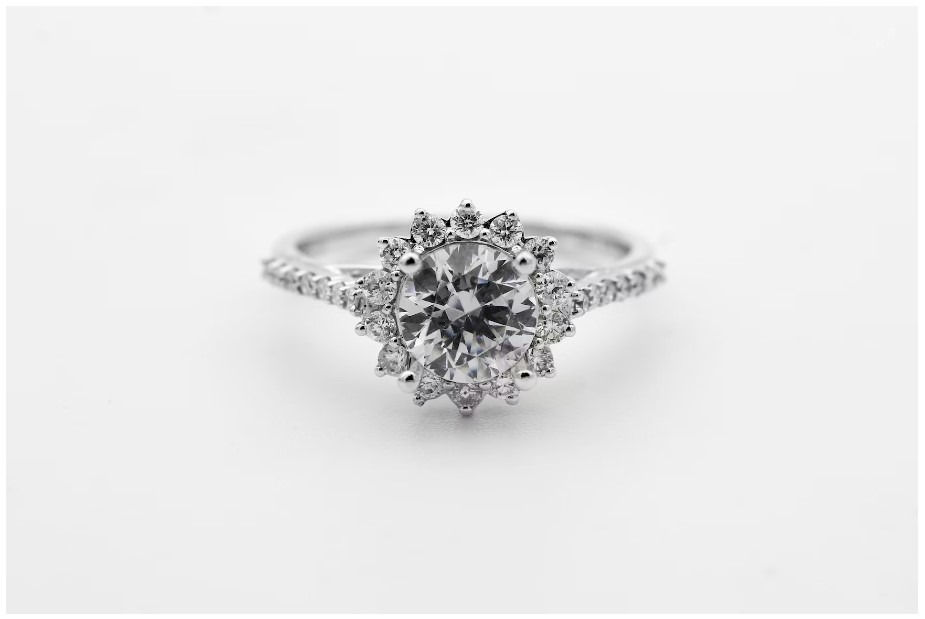
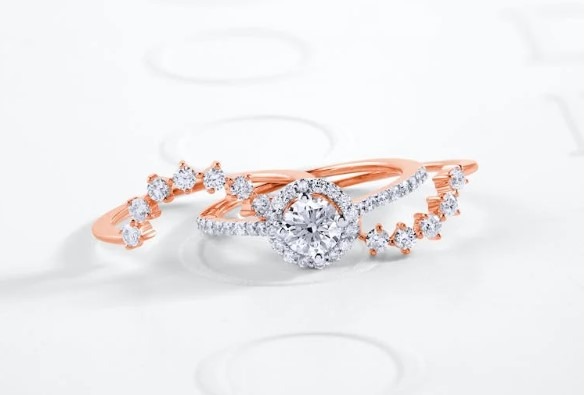
Once you've set your budget, the right setting style can stretch it further than you'd expect. Halo design versatility lets you choose single, double, or hidden halos that maximize sparkle without requiring a larger center stone. Three stone enhanced brilliance adds flanking gems that create layered light reflection, making the entire ring appear more lavish.
- A smaller diamond looks notably larger surrounded by pavé melee stones.
- The circular halo symbolizes eternal love and protection.
- Three-stone designs represent past, present, and future together.
You'll feel confident knowing you maximized beauty within your actual budget. Symbolism in engagement rings serves as a tangible expression of your feelings and commitment, making the design you choose deeply personal and meaningful.
15- How Solitaire, Pavé, and Halo Settings Change Your Total Price
Everything about your engagement ring's final price connects directly to the setting style you choose. Solitaire settings offer the lowest entry point, focusing your entire budget on one quality diamond with minimal metalwork. It's the most practical of all cost-conscious setting choices when maximizing stone quality matters most.
Pavé settings sit at the highest price tier because multiple accent diamonds increase total carat weight and require intensive labor, especially in micropavé variations. Halo settings land in the middle, giving your center stone the appearance of being 30% larger without requiring a bigger diamond purchase. Each halo setting is also custom-made to fit the selected center stone.
Understanding setting style pros and cons helps you allocate your budget wisely. Long-term, solitaire rings also cost less to maintain since fewer small stones mean simpler cleaning and fewer repair risks.
16- Metal Choices That Affect Your Engagement Ring's Durability
Metal choice shapes your engagement ring's long-term durability just as much as the stone or setting. Understanding ring material durability factors helps you select wisely based on your lifestyle. Key alternative metal ring features to evaluate:
- Platinum scratches without losing material, maintains its natural white color, and never needs replating.
- Gold offers resizing flexibility, but lower karats resist daily wear better than higher ones.
- Titanium delivers exceptional scratch resistance and lightweight comfort, though resizing isn't possible.
- Tungsten resists nearly every scratch but can shatter under high impact.
Your daily habits determine which metal protects your ring best. Active lifestyles demand harder metals, while those prioritizing long-term wearability and maintenance ease benefit most from platinum or palladium. Pure gold is soft and must be alloyed with other metals to achieve the strength required for everyday jewelry wear.
17- Best Times of Year to Buy an Engagement Ring for Less
Timing your engagement ring purchase strategically can save you hundreds or even thousands of dollars. Off season discounts peak during January, February, August, and September, when retailer demand drops and clearance sales begin. These quieter months also give you relaxed browsing time and better negotiating leverage.
If your proposal planning timelines align with major sales events, you'll find strong deals on Black Friday, Cyber Monday, and during December year-end clearances. Pre-Valentine's weeks also ramp up promotions despite rising demand, so act early before stock depletes. Subscribe to retailer newsletters and loyalty programs to access exclusive offers.
Comparing lesser-known jewelers alongside established stores often reveals comparable quality at lower prices. Avoid November and December purchases when demand and prices peak simultaneously. Keep in mind that factors like diamond quality and metal type significantly influence the base price of a ring before any discount is applied.
18- Getting Engagement Ring Size Right the First Time
Getting the ring size wrong means a trip back to the jeweler for resizing—a hassle that's easy to avoid with the right approach. Track finger measurements over time—fingers swell in heat and shrink in cold—so measure at different times daily for accuracy.
- Wrap a flexible tape or string snugly around the base of your finger and measure in millimeters.
- Divide that number by 3.14 to get your inside diameter, then match it to a size chart.
- Size up half a size for wider bands over 4mm.
- Confirm results through expert jewelry appraisal or a professional jeweler visit.
If you're between sizes, always choose the larger one—comfort matters every single day you wear it. Keep in mind that frequent resizing can compromise the structural integrity of the ring over time.
19- Dealer Tactics That Cost Engagement Ring Buyers More Than They Should
When shopping for an engagement ring, knowing how dealers inflate costs can save you thousands. Retailers use pressure tactics and negotiation tactics to push spending beyond your means.
- The Salary Myth: De Beers invented the three-month rule to sell more diamonds—not to protect your finances.
- Hidden Markups: Traditional stores charge 20–40% more than online retailers like Blue Nile or James Allen.
- Lab-Grown Silence: Dealers rarely mention lab-grown diamonds, which cost 50% less than natural alternatives.
- Seasonal Pressure: February demand creates artificial urgency, discouraging price negotiation despite stagnant unit sales.
You don't owe anyone three months' salary. Nearly 37% of buyers spend under $2,500. Set your budget first, then shop confidently. Regional cost of living and income levels also shape what couples spend, with buyers in smaller cities averaging just $3,000 to $4,500 compared to $10,000 or more in major metro areas.
20- What a Diamond Certificate Actually Tells You
Once you've chosen a diamond, a certificate tells you exactly what you're buying. Issued by independent labs like GIA or IGI, it confirms diamond certificate grading accuracy across all four Cs—cut, color, clarity, and carat—using standardized tools and trained gemologists.
| Certificate Feature | What It Confirms |
| 4Cs Grades | Cut, color, clarity, carat weight |
| Plot Diagram | Maps inclusions for identification |
| Proportions | Table/depth percentages, girdle thickness |
Diamond certificate security features—holograms, QR codes, microprinting, and watermarks—prevent fraud. A laser-inscribed certification number on the girdle links the physical diamond directly to the lab's database. You can verify authenticity without relying solely on paper documentation, protecting your investment during resale or insurance replacement. Certified diamonds are considered the industry's most reliable diamonds, giving buyers the confidence that the value paid is justified by the quality documented in the report.
21- Engagement Ring Resale Value: What Holds and What Doesn't
That certificate protecting your diamond's identity also plays a direct role in what you'll recover if you ever sell. Understanding ring resale value considerations helps you set realistic expectations. Most sellers recover only 25–50% of retail. Here's what shapes your outcome:
- Certification matters — GIA-certified diamonds consistently attract higher offers and buyer confidence.
- Cut and quality hold value — Round and oval shapes outperform unusual cuts.
- Brand commands premiums — Tiffany or Cartier rings fetch considerably more than generic settings.
- Condition affects offers — Clean, well-maintained rings with original documentation sell stronger.
Key factors that hinder resale value include retail markups, unique cuts, and missing paperwork. Comparing multiple buyers maximizes your final return. Precious metals like platinum and gold retain value better than other alloys, making your metal choice at purchase a factor that echoes through any future sale.
22- Do You Actually Need Engagement Ring Insurance?
Half of all engagement rings go uninsured, yet the average ring costs nearly $6,000—a gap that leaves many couples exposed to real financial loss. Standard homeowners policies cap jewelry coverage at $1,000–$2,500, often covering theft only. Specialized policies cover loss, damage, and natural disasters without affecting your home premium—key policy considerations worth evaluating.
| Ring Value | Annual Premium | Coverage Type |
| $5,000 | $50–$100 | Loss, theft, damage |
| $10,000 | $100–$200 | Includes natural disasters |
| Custom/High-value | Varies by location | Full replacement + value adjustment |
Your lifestyle factors matter too—active individuals face higher loss risk. If you can't afford to replace it, insure it. Millennials aged 25–34 tend to spend the most on engagement rings, averaging $6,700 per ring, making adequate insurance coverage especially critical for this demographic.
23- Daily Habits That Keep Your Engagement Ring Looking New
Once you've nailed down the perfect fit, keeping your ring looking its best comes down to daily habits that take just minutes. Wipe your ring regularly with a lint-free cloth to remove surface oils before they build up. Remove it before workouts, swimming, applying lotions, or handling cleaning chemicals. Let sanitizers and moisturizers fully absorb before putting it back on.
Proper storage techniques matter too. Keep your ring in a soft cloth pouch or dedicated ring box when you're not wearing it, and designate a consistent spot during chores or skincare routines. Comprehensive insurance typically costs just 1-2% of your ring's value annually, making it a smart and affordable way to protect your investment.
24- When Your Engagement Ring Needs Professional Inspection
Even with consistent at-home care, your engagement ring needs professional attention every six months to stay in top condition. Proper inspection scheduling safeguards both the ring's value and the memories it carries. Watch for these common inspection triggers:
- Bent, broken, or snagging prongs that catch on fabric or feel unusually sharp
- Loose or shifting stones that rattle or move noticeably within the setting
- Diminished sparkle caused by stubborn grime buildup in hard-to-reach areas
- Visible chips or hairline cracks that only specialized magnifying equipment can confirm
A jeweler's thorough inspection covers your setting, prongs, and stones, then follows with cleaning, polishing, and immediate repairs. Don't wait until something feels wrong — routine professional maintenance guarantees your ring lasts a lifetime. Between professional visits, performing monthly self-checks allows you to catch bent prongs or loose stones before they lead to a costly replacement.
25- Engagement Ring Budget Strategies That Actually Stretch Further
Planning an engagement ring purchase around a thoughtful budget starts with one critical shift: base your numbers on net monthly income — what you actually take home after taxes — not your gross salary. Lifestyle aligned budgeting strategies replace outdated rules like the "three months' salary" formula, a 1940s marketing invention with no relevance to your actual finances.
Assess your fixed expenses, existing debt, and long-term goals before setting a number. Affordable customization options — like choosing a 0.9-carat diamond over a full carat or selecting white gold instead of platinum — stretch your budget without sacrificing quality. Automatic savings tools and a defined timeline make accumulation manageable. Payment plans offering 6–12 month installments provide additional flexibility, and wire transfers frequently open 1–3% discounts from jewelers.
Conclusion
Engagement rings carry meaning—but they also carry expectations. Between tradition, marketing, and modern visibility, it’s easy to feel like there’s a “right” way to buy one. In reality, there isn’t. The best decisions come from understanding what matters: quality, durability, budget, and personal significance.
When you focus on those factors, the process becomes simpler—and the result becomes more meaningful. Because in the end, the value of an engagement ring isn’t defined by its size or price. It’s defined by what it represents—and how well it fits the life it’s part of.